Math Log Newsletters
The newsletter of the University of North Dakota Mathematics & Statistics Department.
Issue 51, 2025-26
The UND Department of Mathematics and Statistics hosted the 2025 Annual Midwest Optimization Meeting (MOM) on Oct. 31-Nov. 1. The MOM is an annual research-oriented conference in which mathematical researchers present and listen to scholarly talks related in some way to the idea of optimization. A different college or university hosts the MOM each year.
In a mathematical sense, optimization is the process of finding the best solution to a mathematical problem. This often means finding the maximum or minimum value of a function subject to some set of conditions, but the term “optimization” is also used in a broader sense. Optimization is the subject of a significant amount of current mathematical research. The Web site for the 2025 MOM states that “the main objectives of the 2025 Midwest Optimization Meeting are to communicate recent advances and developing trends in optimization, convex and variational analysis, computational mathematics and . . . their applications such as to control, machine learning/data analytics, logistics, and multi-disciplinary design optimization domains.”
The organizers of the 2025 Midwest Optimization Meeting invited four plenary speakers to come and give talks. Approximately 30 other participants presented “contributed” talks. The contributed talks occurred during three parallel (simultaneous) sessions. When a plenary talk was occurring, however, that talk was the only talk taking place at the conference at that time. All of the talks at the 2025 MOM took place at UND’s Memorial Union (the student union).
A total of approximately 80 people, including the conference speakers, attended the 2025 MOM. This total may not include a few participants from UND who attended all or part of the conference without formally registering with the conference organizers. The four plenary speakers were affiliated with Wayne State University, the University of Washington, the University of Waterloo, and Michigan State University, respectively. The other participants at the conference came from UND, North Dakota State University (NDSU), Kent State University, the University of Central Florida, the University of Minnesota, Loyola University Chicago, Umeå University (Sweden), the University of British Columbia, San Diego State University, South Dakota State University, and several other colleges and universities.
Many participants at the 2025 MOM were students who traveled to the conference from distant locations. To assist these students, the conference organizers applied for and received grant of $31,200 from the United States National Science Foundation (NSF). The organizers used these funds to pay for portions of the travel and lodging expenses of many of the students who came to the conference from other locations. The conference organizers used funds from the UND Department of Mathematics and Statistics to pay for the travel and lodging expenses of the four plenary speakers. For many years, the department has had various accounts containing funds which it uses for various expenses as they arise. It used funds from these accounts to pay for the travel and lodging of the plenary speakers.
UND faculty members Drs. Bryce Christopherson, Adewale Lukman, Thanh Phat Vo, and Ryan Zerr organized the 2025 MOM. All four of these organizers currently serve in the UND Department of Mathematics and Statistics. The original application, or “grant proposal,” for NSF funding for the 2025 MOM listed Drs. Christopherson, Lukman, Vo, and Zerr as “investigators.” Dr. Zerr was the “Principal Investigator” (PI), and Drs. Christopherson, Lukman, and Vo were “Co-Principal Investigators” (co-PIs).
Dr. Vo was instrumental in bringing the 2025 MOM to UND. He had attended the MOM regularly since 2019. By attending the conference, he was able to meet many of the people who were involved with the conference, and he became familiar with the organization and general procedures of the MOM. During the 2024 MOM, the organizers asked for volunteers to host the next MOM. Dr. Vo was interested in hosting the MOM. After his return to Grand Forks, he talked to Mathematics and Statistics Department Chair Dr. Ryan Zerr. The two discussed the possibility of having UND host the 2025 MOM. Dr. Zerr was very supportive of the idea. Drs. Vo and Zerr decided to proceed with planning of the conference and the NSF funding proposal for the conference. Dr. Zerr played a key role in what followed. Drs. Vo and Zerr asked Drs. Christopherson and Lukman to join them in the planning for the conference. Dr. Vo emphasized that all four of the 2025 MOM organizers contributed to the planning and organizing of the conference. The 2025 MOM at UND would not have been possible without this collective effort.
We would like to thank everyone who attended all or part of the 2025 Midwest Optimization Meeting and all of the people who made this meeting possible! Research activity in our department is increasing, and more conferences similar to MOM may occur here in the years to come. Watch for more news!
In the spring of 2025, UND Mathematics and Statistics faculty member Dr. Jeremiah Bartz taught in-person classes at the American College of Norway (ACN) in Moss, Norway, near Oslo, Norway. ACN is very small. Approximately 50 students are admitted to the college each year. All instruction at ACN occurs in English, and several faculty members there are Americans. ACN provides Norwegian students with the opportunity to learn about the American college education system. Most students at ACN study there for only a year or so. Many go on to pursue bachelor’s degrees at American colleges and universities. They often use their coursework at ACN to fulfill a portion of the degree requirements for a bachelor’s degree from a school here in the U.S. The American College of Norway is also a good place for its international (foreign) students to learn about Norway and Norwegian culture. Many of these international students are Americans.
Except for a few excursions, Dr. Bartz was at ACN for the entire Spring 2025 semester. He taught three courses during this period. All of these courses were aimed at a general audience as opposed to mathematics, engineering, and science majors. Dr. Bartz’s first course was an introductory course in cryptology, the science of encoding and decoding secret messages. Among other things, the students studied the Enigma machine, a cipher machine that the Germans used during World War II. At one point in the course, Dr. Bartz took his students on a field trip to a museum where they saw an actual Enigma machine.
Dr. Bartz also taught a course on cultural mathematics, i.e. the mathematics of various other cultures, such as indigenous cultures in the Western Hemisphere. One example he discussed in the class was number systems. He described how some cultures have used a base 20 number system instead of the base 10 system that we use. Dr. Bartz’s third course was a general interest course for nontechnical majors which dealt with the applications of mathematics to problems in society.
Ever since his arrival here at UND as a tenure-track professor, Dr. Bartz has always worked on mathematical research and scholarly activity. This work continued during his service in Norway. He specifically mentioned a talk he gave at the conference Dutch Days of Combinatorics in the city of Delft, in the Netherlands, in the spring of 2025.
Spitsbergen
During his service in Norway, Dr. Bartz also did a few things that were not so closely related to mathematics. In March of 2025, during American College of Norway’s spring break, the director of the college led a group of students on a field trip to Spitsbergen. Dr. Bartz went along on the field trip. Spitsbergen is an island in the Arctic Ocean. It is part of Svalbard, a chain of islands off of the northern coast of the Norwegian mainland. The group stayed at Longyearbyen, a town of about 2500 people located on Spitsbergen. Longyearbyen is the largest town on Svalbard and the northernmost town of its size in the world.
While on Spitsbergen, the group of students, along with Dr. Bartz, went on a dog-sledding expedition. The weather was very cold. The participants wore some very special warm clothing. Dr. Bartz enjoyed the dogsledding experience, but he was happy to go indoors afterwards!
People on Spitsbergen occasionally see polar bears. Polar bears will occasionally attack humans. People who venture out of Longyearbyen must carry a rifle to protect themselves. Within the town of Longyearbyen, there is a warning system to alert people when a polar bear is in the vicinity.
Dr. Bartz learned about teaching opportunities at the American College of Norway while attending a workshop for mid-career faculty. Dr. Daphne Pedersen encouraged him to submit an application to teach at ACN, and he did so. Dr. Pedersen is a Professor in UND’s Sociology Department and an Associate Dean at UND’s College of Arts & Sciences. Dr. Bartz is grateful to our department Chair, Dr. Ryan Zerr, Arts & Sciences Dean Dr. Bradley Rundquist, and UND Provost Dr. Eric Link, for approving his travel to ACN and his teaching work there. Professor Bartz is also grateful to the students and staff at ACN. The students made his semester at ACN a memorable one, and the staff were wonderful hosts!
We would like to thank Dr. Bartz for telling us about his experiences in Norway!
Department of Mathematics and Statistics faculty member Gwennie Byron has been selected to receive the UND McDermott Faculty Award for Excellence in Undergraduate Teaching.
Byron is one of two UND faculty members to receive this award for the 2025-26 academic year. Byron is currently the Director of UND’s Math Active Learning Lab (the MALL). Instruction for many introductory Mathematics courses occurs at the MALL. Byron directs the MALL and its staff. She is also the instructor of record for a few courses. Byron currently holds the rank of Teaching Associate Professor.
UND Mathematics and Statistics Department faculty member Dr. Ryan Zerr gave the main commencement address at the UND 2025 Summer Commencement ceremony. A transcript of the speech is available. Dr. Zerr joined the UND Mathematics and Statistics Department as a tenure-track faculty member in 2003. He currently serves as our department’s Chair. Dr. Zerr has also served in several administrative positions outside of the Department of Mathematics and Statistics. He is currently UND’s Associate Vice President for Strategy & Implementation (in addition to serving as our department’s Chair).
Two visitors recently came to the UND Department of Mathematics and Statistics to present talks. Both talks were part of the Edward O. Nelson Memorial Lecture Series. Dr. Nelson was a faculty member in our department for many years. He first came to our department in 1950, and he retired in 1993.
Dr. Adam M. Goyt presented the talk “The Magic of de Bruijn Sequences” here on Jan. 22, 2025. Dr. Goyt serves in the Department of Mathematics at Minnesota State University Moorhead.
Dr. Carl Olimb presented the talk “Quasicrystals and Quantum Codes: Error Correction from Aperiodic Tilings” on Sept. 19, 2025. Dr. Olimb is a professor in the Mathematics Department at Augustana University in Sioux Falls, S.D. He completed a master’s degree in Mathematics here at UND in 2004.
Three new faculty members joined the Department of Mathematics and Statistics last fall. All are serving at the rank of Teaching Assistant Professor.
Seth Glasser is originally from Bismarck, N.D. He received his M.S. degree in Mathematics here at UND in 2020. In his spare time, he enjoys birdwatching, strategy games, reading, and going for long walks with his wife Carly and their dog Hazel.
Ganesha Thondilege is originally from Matara, Sri Lanka. She completed her M.S. degree in Mathematics here UND in 2025. As far as her mathematical interests are concerned, she is interested in applied mathematics in real-world situations as well as the role of mathematics and statistics in image processing.
“During my free time, I enjoy drawing and painting, exploring creativity through colors, and gardening, where I find peace and satisfaction in nurturing plants and watching them grow,” she said.
Michael Preheim is from the town of Armour, S.D. He holds a Ph.D. degree in mathematics from North Dakota State University (NDSU), where he studied undergraduate mathematics education.
“My doctoral research focused on student metacognition in an introductory linear algebra course and student metacognition as it pertains to proof comprehension,” Preheim said. Michael has several interests outside of mathematics and education. He writes, “I am active in music activities, such as playing piano, composing, and singing. I also spend much of my free time playing games of many varieties including board games, card games, and video games. Lastly, I truly enjoy just spending time hanging out with my wife, my dog, and my cat at home!”
Alesh (Tunde Alesinloye) received his M.S. degree in Mathematics in May 2025. He wrote a master’s thesis entitled “Mathematical Modeling of cyberphysical attract in IOT system: An Epidemiological Approach.” His advisor was Dr. Bryce Christopherson.
“I plan to pursue a Ph.D. in Mathematics and further develop research expertise in mathematical modeling, cybersecurity, and applied analysis,” he said.
Oscar Edem Mawutor completed his M.S. degree in Applied Statistics in May 2025. He prepared an independent study report entitled “Addressing linear dependency in Waring regression models using a modified ridge estimator.” His advisors were Drs. Adewale Lukman and Gerri Dunnigan. Oscar is currently serving as a high school mathematics teacher at Libertas Academy Charter School in Springfield, Mass.
Daniel Kwakye wrote an M.S. thesis entitled “Thresholds in Modular Lattices” under the guidance of his advisor Dr. Bryce Christopherson. He completed his M.S. in Mathematics here at UND in May 2025 and has since started a teaching job in mathematics. He hopes to begin work on a Ph.D. soon.
Ganesha Thondilege received her M.S. degree in Mathematics here at UND in May 2025. Her advisor was Dr. Bryce Christopherson. She wrote a master’s thesis entitled “AdaptBlur: Adaptive Linear Filter for Enhanced Deep Learning Classification Performance.” Ganesha is currently a Teaching Assistant Professor in the UND Department of Mathematics and Statistics.
Wolfgang Nnchiiffor (B.S. 2014) is now an anesthesiologist working in Ohio and Pennsylvania. While still a UND student, his name was Joseph Awa Nchifor, but he has since changed his name during the naturalization process.
Kirsten Hogenson (B.S. 2010) serves in the Department of Mathematics and Statistics at Skidmore College in Saratoga Springs, N.Y. Saratoga Springs is located a few miles north of Albany, N.Y. Kirsten was recently granted tenure and promoted to the rank of Associate Professor. The promotion became effective on June 1, 2025. We congratulate Professor Hogenson for her promotion and tenure!
Nancy Maaseneh Alandu is from the Upper West Region of Ghana. She completed her undergraduate degree in Mathematics at Valley View University.
Sean O. Hettervig is from Mayville, N.D. He received his B.S. degree from Mayville State University, where he majored in Mathematics and minored in General Science.
Karen Robinson received her B.S.Ed. degree in Mathematics-Secondary Math Education at Minot State University in Minot, N.D. She is originally from Minot.
“I’m licensed to teach grades 5- 12 math, as well as substitute teach, in North Dakota. I am interested in teaching mathematics at the college/university level once I get my master’s degree,” said Robinson.
Cora (Corey) Reinholt is from Renick, a town in the mountains of West Virginia. Corey received her bachelor’s degree here at UND, where she majored in Mathematics and Spanish.
“One of my interests is mathematical biology. I became interested in mathematics through learning about genetics," said Reinholt. "Too late, I realized that I liked theory more than lab work. While I was working on my B.S. in mathematics, I had the opportunity to work on a turtle genomics project with [UND Biology Department faculty members] Drs. Turk Rhen and Rebecca Simmons. Through the project, I learned I had an interest in phylogenetic combinatorics.”
Corey is currently working on a research project involving gerrymandering in political districts. The research project began as joint work with UND Mathematics Department faculty member Dr. Ryan Zerr. One of Corey’s hobbies is writing fiction.
- Dr. Bryce Christopherson and Jack Baretz have published the article “When do the Kahn-Kalai bounds provide nontrivial information?” in the Journal of Inequalities and Applications.
- Dr. Adewale Lukman and his collaborators have recently published the following research articles: (1) “Mitigating multicollinearity in zero-inflated negative binomial regression using the modified Kibria-Lukman estimator,” (2) “Modified ridge estimator in the Bell regression model,” and (3) “Optimised block bootstrap: an efficient variant of circular block bootstrap method with application to South African economic time series data.” These articles have appeared in the following respective journals: (1) AIMS Mathematics, (2) the Journal of Inverse and Ill-Posed Problems, and (3) AIMS Mathematics.
- Dr. Thanh Phat Vo and his collaborators have recently published the following scholarly articles: (1) “Local minimizers of nonconvex functions in Banach spaces via Moreau envelopes,” (2) “Second-order subdifferential optimality conditions in nonsmooth optimization,” and (3) “Inexact proximal methods for weakly convex functions.” These articles have appeared in the following respective journals: (1) the Vietnam Journal of Mathematics, (2) the SIAM Journal on Optimization, and (3) the Journal of Global Optimization.
- Timothy Prescott has published the article “Seeding Statistics of Elimination Tournaments” in the journal Scatterplot.
- Krista Lynn Minnotte & Michael C. Minnotte have published the article “Caregiving Penalties? Outcomes of Perceived Family-Responsibilities Discrimination Among U.S. Caregivers” in the journal Sociological Focus.
- Gerri Dunnigan and Radha Panini published the article “Five Years Later: Revisiting an Applied Calculus Reform Project and Its Impact on Subsequent Calculus Reforms, Pre- and Post-Pandemic” in a special issue of the journal PRIMUS.
- Derek Krepski, Jordan Watts, and Seth Wolbert have published the scholarly article “Sheaves, principal bundles, and Čech cohomology for diffeological spaces” in the Isreal Journal of Mathematics.
Mathematics and Statistics Department faculty member Dr. Gerri M. Dunnigan has been promoted to the rank of Full Professor. We congratulate Professor Dunnigan for her promotion, and we thank her for her contributions to our department and the work she has done with our students!
The 2024-25 Mathematics Track Meet took place on the UND campus on Jan. 13, 2025. Our department hosts this event each year. The Math Track Meet is a competitive event for selected students in grades 6 through 12 from the Grand Forks area. A total of 218 students from 14 different schools participated in the event. Numerous faculty members and students from our department wrote and graded exams for the Math Track Meet or assisted with the event in other ways.
Until recently, the Hyslop Sports Center stood across the street from Witmer Hall, the home of the UND Department of Mathematics and Statistics. Workers demolished the Hsylop Sports Center in the summer of 2025. UND is constructing a new STEM complex on the site of the old Hyslop Sports Center. STEM stands for “Science, Technology, Engineering, and Mathematics.”
The Department of Mathematics and Statistics has offered scholarships to several students for the 2025-26 academic year. The recipients of the scholarships were as follows:
- Morgan Blair (Buster and Margie Martin Scholarship)
- Hudson Juel (Judy Ann Utton Memorial Scholarship)
- Gabrielle Wahl (Patrick Durkin Memorial Scholarship)
- Justin Filler (Paul Bruce Waterside Enterprises Scholarship)
- Kaylee Nelen (Brent Christensen Mathematics Scholarship)
- Casia Steinhaus (James Rue Mathematics Scholarship)
- William Beuning, Tucker Pearson, and Oscar Lindemann (Jay O. & Marie Bjerkaas Math Scholarship)
- Christian Schultz and Brady Helbling (Ronald C. and Ann C. Bzoch Memorial Scholarship)
- Dylan Jechort (Deann and Lee Christianson Scholarship)
- Braedon Manecke (David Uherka Mathematics Scholarship)
- Karter Peterson (Paige Plagge Memorial Math Scholarship)
- Madelyn Gallant (Joseph A. Guzek Mathematics Scholarship)
- Payton Bergeron (Diana L. Wells Memorial Mathematics Scholarship)
- UND’s College of Arts and Sciences has awarded the John and Lyle Buchwitz Scholarship to Gloria Antwi-Boasiako.
by Larry Peterson
This issue of the Math Log will be the last issue for which I will be serving as editor. I will be retiring from UND in May 2026. My service as a tenure-track faculty member here at UND began in August 1998. I will reach my “full” Social Security retirement age shortly before my retirement in May, so I feel that this is an appropriate time to retire. Our department Chair, Dr. Ryan Zerr, values the Math Log, and he would like to see it continue. I think he will find someone to replace me as the Math Log editor.
In many ways, I have been very lucky to have had the opportunity to serve my department, our students, and our college and university. I have enjoyed editing the Math Log for many years. As editor of the Math Log, I sometimes receive mail from alumni. I enjoy receiving news from my former students and from people who were here long before I came here. I have also enjoyed writing about the accomplishments of people in our department. If you have been reading the Math Log for a while, you will know that I have interviewed numerous people and written summaries of these interviews for the Math Log. The interviews required quite a bit of work, but they were interesting. I learned something about people in different walks of life. I hope that many of you have enjoyed reading the interview articles, and I hope that you have learned something from them.
My work here at UND has also included teaching, research, and other types of service in addition to my work with the Math Log. I was lucky to have had the chance to pursue these activities here. All of these activities were important, but I spent more time on teaching than I spent on the other activities. Teaching is important. Students need to obtain the skills they will need for their careers. They will obtain many of these skills by experience on the job, but formal university coursework is also important for career training. Having said this, I would like to emphasize that university studies should involve more than just training for careers. Liberal arts education is also an important part of a good university education. Students need to understand the world around them and the forces and events that have made our world what it is today. The study of mathematics and statistics is part of liberal education, but we also need to value study in other technical and nontechnical disciplines.
In the years since my arrival here in 1998, I have also worked on scholarly research. I have published a small number of mathematical research articles. You should be aware, however, that research in our department is increasing. Further information is available elsewhere in this issue of the Math Log as well as in recent past issues. Watch for more news about research in the next issue of the Math Log. We appreciate the work of all of our faculty members, but it is especially important to appreciate the work of our more active researchers. Research is a good thing. UND is a general purpose university, and we need to have research here.
These are only my opinions, of course. I do not speak for the University as a whole. To see UND’s overall mission statement, visit the Strategic Plan.
Thank you for reading this Pseudo-Sum column and thank you for reading this issue of the Math Log! Many of you have made financial contributions to our department and to our scholarships. Thank you for this! Send us news concerning your activities! In your day-to-day lives, be positive and courteous! Try to make it look as if you are positive! Keep reading the Math Log, even if it changes in some ways! Good luck in your endeavors!
Visit the Faculty & Staff webpage to see a full list.
The following persons are responsible for monetary gifts to the UND Alumni Association & Foundation specifically designated for the improvement of the Department of Mathematics & Statistics. We thank you for your generosity!
- Benevity
- Cathy D. Adams
- Dr. Gail S. Nelson
- Jean M. Neumiller
- Nadjah J. Larson
- Corinne & Brian Jacobson
- Daniel G. Hinnenkamp
- Dr. Julie N. Getty
- John Clynch
- Patricia J. Lund
- Carol Hokana & Nick Bonifanti
- Drs. Douglas & Susan McLeod
- Joseph & Joyann Guzek
- Larry D. Rafferty
- Col. (Ret.) Greg & Jey Stolt
- Drs. Sandra & Richard Paur
- Rodney & Marlys Kjellberg
- Michael B. Kalina
Ronald C. and Ann C. Bzoch Memorial Scholarship
- Dr. L Thomas Ramsey
- Maryanne & Russ Romero
Judy Ann Utton Memorial Scholarship
- Bruce & Lori Anderson
Jay O. and Marie Bjerkaas Math Scholarship
- Forrest & Susan Bjerkaas
Patrick Durkin Memorial Scholarship
- Christopher Smith
- James & Leslie Durkin
- Kelly C. Maynard
- Seth & Katie Greicar
- Mark Gonitzke
- Leslie & James Durkin
- Benevity
Paul Bruce Waterside Enterprises Scholarship
- Colleen Bruce
- Paul V. Bruce
Brent Christensen Mathematics Scholarship
- Brent M. Christensen
Joseph A. Guzek Mathematics Scholarship
- Joseph & Joyann Guzek
David Uherka Mathematics Scholarship
- Dorothy & Dr. Dave Uherka
- Dr. Timothy J. Pennings
- Rodney B. McKinney
Buster and Margie Martin Distribution Fund
- Dr. Mary P. Bryngelson
If you would like to make a monetary contribution to UND, to the UND Mathematics & Statistics Department, or to one of our scholarship funds, visit the UND Alumni Association & Foundation.
Issue 50, 2024-25
The UND Mathematics Department has changed its name. We are now the Department of Mathematics & Statistics. The name change helps highlight opportunities for students interested in statistics, but you can be assured that our department still offers virtually all of the courses in mathematics that it has offered in recent years.
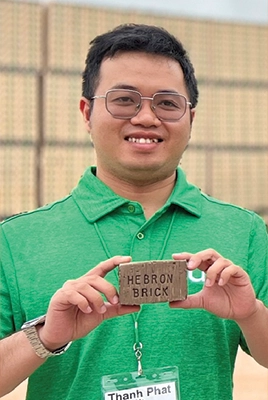 Dr. Thanh Phat Vo began service as a tenure-track faculty member here in the Department of Mathematics
and Statistics last fall. Dr. Vo completed his Ph.D. degree in Applied Mathematics
at Wayne State University in Detroit, Michigan in 2024. He had previously earned
a Bachelor’s Degree in Mathematics Teacher Education from Ho Chi Minh City University
of Education in Vietnam in 2018. He served as a lecturer in the Department of Mathematics
and Informatics at Ho Chi Minh City University of Education from October 2018 to September
2019.
Dr. Thanh Phat Vo began service as a tenure-track faculty member here in the Department of Mathematics
and Statistics last fall. Dr. Vo completed his Ph.D. degree in Applied Mathematics
at Wayne State University in Detroit, Michigan in 2024. He had previously earned
a Bachelor’s Degree in Mathematics Teacher Education from Ho Chi Minh City University
of Education in Vietnam in 2018. He served as a lecturer in the Department of Mathematics
and Informatics at Ho Chi Minh City University of Education from October 2018 to September
2019.
Dr. Vo is an active researcher. He writes, “My main research areas are nonsmooth optimization and variational analysis, focusing on both theoretical and numerical aspects with applications in machine learning and statistics.” He goes on to say, “Variational Analysis is a powerful branch of applied mathematics that deals with nonsmooth phenomena in optimization, including equilibrium, control, perturbation, and approximation challenges in both linear and nonlinear systems.” Dr. Vo has published numerous scholarly articles. Three of his articles have recently been accepted for publication.
Dr. Vo enjoys teaching classes. He writes, “I am passionate about teaching graduate-level courses in analysis, including Introduction to Analysis, Modern Analysis, Numerical Analysis, and Topology, as well as applied mathematics courses like Optimization (with potential applications in machine learning and statistics), Mathematics of Finance, Mathematical Modeling, and Optimal Control. Dr. Vo grew up in the city of Quang Ngai in Vietnam, and his parents and younger sister still live in Vietnam. Dr. Vo is currently single. In his spare time, he enjoys swimming and cooking Vietnamese cuisine.
Photo: Taken at the Hebron Brick Company while Dr. Vo was on a tour of North Dakota with UND President Andrew Armacost and several new UND faculty members.
On March 14, 2024, UND Mathematics and Statistics Department alumni Danica (Belanus) Allard (M.S. 2012), Jeremiah Bartz (M.S. 2006), and Katrina (Nagel) Eberhart (M.S, 2007) gave a presentation to a group of inmates at the North Dakota State Penitentiary in Bismarck, North Dakota. The presentation took place on Pi Day (March 14, 2024). Pi Day is named after the number π. As you may know, π = 3.14, after rounding. Note the similarity between the number 3.14 and the date 3/14! Teachers and students of mathematics across the U.S. celebrate Pi Day on March 14 each year. Pi Day is a celebration of the number π and mathematics in general.
Dr. Bartz began the presentation by discussing graph theory. He then had his students work on problems in graph theory. After a short break, Mrs. Allard and Dr. Eberhart discussed cryptography (the science of encoding and decoding secret messages). They then had the inmates engage in an interactive activity in which they (the inmates) decoded humorous messages. Mrs. Allard notes that the students (the inmates) seemed to enjoy the presentations and the activities.
In the months following the March 14 presentation, Mrs. Allard and Dr. Eberhart have continued to visit the inmates at the Bismarck State Penitentiary. Every other week, either Mrs. Allard or Dr. Eberhart conducts a “math circle” activity for students at the prison.
The 2024 Pi Day presentation and visit by Mrs. Allard and Drs. Bartz and Eberhart was made possible in part by the Prison Mathematics Project. One of the main purposes of the Prison Mathematics Project is to use interest in mathematics to help prison inmates rebuild their lives and refrain from criminal activities. Further information on the Prison Mathematics Project website.
Dr. Bartz is currently an Associate Professor in the Department of Mathematics and Statistics here at UND. Mrs. Allard and Dr. Eberhart are Associate Professors of Mathematics at Bismarck State College in Bismarck.
Mrs. Allard has written an interesting article concerning the March 14, 2024, presentation. To see this article, visit the Web site for the Prison Mathematics Project which we mentioned above. Then follow the link to “Read our newsletters.” Finally, open the Fall 2024 newsletter and go to page 17 of this newsletter. Much of the above information concerning the Pi Day presentation came from Mrs. Allard’s article.
Nick Holmes graduated with his M.S. degree in Mathematics in May of 2024. He completed an independent study report entitled “Hurwitz Zeta Function and L-Functions” under the guidance of his adviser, Dr. Anthony Bevelacqua. Nick is currently attending North Dakota State University, where he is pursuing a Ph.D. in Mathematics.
Sumaiya completed her M.S. degree in Mathematics here at UND in December of 2024. Her advisor was Dr. Ryan Zerr. The title of Sumaiya’s independent study report was “An examination of Hilbert Spaces.” Sumaiya is starting a job as an adviser for students. She plans to continue on to earn a Ph.D. degree when the opportunity arises.
Gloria Antwi-Boasiako is from the city of Kumasi, Ghana, in West Africa. She completed her bachelor’s degree in Mathematics at the Kwame Nkrumah University of Science and Technology in Kumasi. Gloria writes, “One interesting thing about me is that I find harmony in the intersection of math and music. My passion for mathematics surprisingly fuels my love for music, revealing the hidden rhythms and patterns that govern both art forms.”
Grace Fatoyinbo is from Omuo-Ekiti, Nigeria. She studied at Ekiti State University, in Nigeria, where she completed a bachelor’s degree with a major in Mathematics and a minor in Physics.
Loran Elton is from New Town, North Dakota. He recently completed his bachelor’s degree in Mathematics here at UND. For hobbies, Loran enjoys programming projects. He writes, “I enjoy finding ways to implement what I’ve learned from math courses into personal programming projects. The most recent adventure has been taking [two-dimensional] slices of Tessarines1 under recursive mappings with domain coloring.”
1. According to the online encyclopedia Wikipedia, a tessarine is a certain type of hypercomplex number.
Caleb Larson joined the Mathematics and Statistics Department in the fall of 2024 and now serves as the Associate Director of UND’s Math Active Learning Lab (the MALL). He holds an M.S. degree in Mathematics from North Dakota State University (NDSU). He is originally from Reeder, North Dakota. He is married to Aloysia Larson, who also serves here in the UND Mathematics Department. When he is not working, Mr. Larson enjoys playing card games and board games with friends. Caleb and Aloysia also enjoy exploring the various walking paths in Grand Forks with their dogs Buddy and Dobby.
Dr. Seth Wolbert also joined our department in the fall of 2024. Dr. Wolbert is originally from Kalamazoo,
Michigan. He completed his Ph.D. degree in Mathematics at the University of Illinois
at Urbana-Champaign. In his spare time, Dr. Wolbert enjoys hiking with his dog, cooking,
and learning Spanish.
Andrew Abraham is originally from St. Cloud, Minnesota. He also joined the Department of Mathematics
and Statistics in the fall of 2024. He completed his B.S. degree in Mathematics at
UND here in Grand Forks and his M.S. degree in Mathematics at Montana State University
in Bozeman, Montana. Mr. Abraham currently lives in Bozeman and teaches online classes
for UND. Mr. Abraham writes, “If I am not teaching math, you can find me out on the
dance floor teaching country swing dancing. My other hobbies include hiking, playing
guitar, and drawing. I have [a] 2-year-old border collie named Euler who is ball-obsessed
and full of energy.”
Adewale Lukman, Abiola Owolabi, Olukunmi Akanni, Charles Kporxah, and Rasha Farghali have published the article “Robust Enhanced Ridge-Type Estimation for the Poisson Regression Models: Application to English League Football Data” in the International Journal of Uncertainty, Fuzziness and Knowledge-Based Systems.
Rasha Farghali, Adewale Lukman, and Ayodeji Ogunleye have published “Enhancing model predictions through the fusion of Stein estimator and principal component regression” in the Journal of Statistical Computation and Simulation.
The article “Powers of two as sums of two balancing numbers,” by Jeremiah Bartz, Bruce Dearden, Joel Iiams, and Julia Peterson, has appeared in the book Combinatorics, graph theory and computing. This book is part of the Springer Proceedings in Mathematics & Statistics.
Jerry Myhre (Ph.B., 1965) is a retired United Airlines captain. Jerry has three children and five grandchildren. Jerry and his wife Karen live at 7 Edgewood Drive, Geneseo, IL 61254. You can reach Jerry by email at hiflier320@gmail.com.
The Department of Mathematics and Statistics has offered scholarships to several students for the 2024-2025 academic year. The students were as follows:
- Mataya Anderson (Patrick Durkin Memorial Scholarship)
- Tunde Alesinloye and Tobias Tamakloe (Paul Bruce Waterside Enterprises Scholarship)
- Joshua Dorsam (Brent Christensen Mathematics Scholarship)
- Vu Nguyen (James Rue Mathematics Scholarship)
- Braedon Manecke, Jonathon Hasbargen, Curtis Sande, and Jack Kern (Jay O. & Marie Bjerkaas Math Scholarship)
- Amanda Thompson, Audrey Rubish, Casia Steinhaus, Matthew Johnson, and Tay-Lin Nitschke Durben (Ronald C. and Ann C. Bzoch Memorial Scholarship)
- Liam Turman (Deann and Lee Christianson Scholarship)
- Noah Cowley (David Uherka Mathematics Scholarship)
- Joshua Dorsam (Paige Plagge Memorial Math Scholarship)
- Jacob Stanley (Joseph A. Guzek Mathematics Scholarship)
- Morgan Blair (Diana Wells Scholarship)
- Jonathon Hasbargen (Judy Ann Utton Memorial Scholarship)
- UND’s College of Arts and Sciences has awarded the John and Lyle Buchwitz Scholarship to Tunde Alesinloye
Professor Thomas L. Richards retired from service here in the Mathematics and Statistics Department at the end of the Spring 2024 semester. Dr. Richards received his Ph.D. in Mathematics from Washington State University in 1991 and began service in the UND Mathematics Department in the fall of the same year. At the time of his retirement, he had attained the rank of Associate Professor.
Shortly after Dr. Richards retired, the Math Log editor sent him some questions by email. Some of the questions follow, along with slightly edited versions of Dr. Richards’s answers.
Did you have any especially close friends here?
I liked everyone I worked with, but I suppose I was closest to Tom Gilsdorf. We shared an office at Washington State University as graduate students and had a habit in grad school of getting together occasionally to drink beer, eat pizza, and watch the most outrageously bad movies--usually bad horror movies--that we could lay our hands on at the video store. (This was way back in the olden days when there were stores at which you could rent VHS tapes.) The goal was to get movies that were so bad that they were funny, and it was not hard to succeed at this goal. In fact, when I came out to interview for the job here at UND, Tom and I did that very thing in my motel room the night before I gave my talk for the department. I should have been reviewing my notes and getting a good night’s sleep instead, I suppose. I am still in regular contact with Tom.
I also spent a lot of time with Jerry Metzger, either working on math problems or just talking and laughing it up. I played chess with him for a while, and had a record of something like one win and fifty losses. I really enjoyed that one win, though. We stayed in touch after he retired. We had a number of common interests, such as old movies, trying to make sense of quantum mechanics, especially the double-slit experiment1, and boasting of our speed in solving the Sudoku puzzle in the New York Times.
Did you work on any joint projects of any kind with any other faculty members here?
I spent a great deal of time with Jerry Metzger working on the problems presented in the MAA2 journals (the American Mathematical Monthly, the Mathematics Magazine, and the College Mathematics Journal). We sometimes made use of the Bob Tomper name. (Editor’s note: “Bob Tomper” was the name of a fictitious student. Some UND Mathematics Department faculty have occasionally used this name as a pseudonym in certain contexts.) We also solved a problem that he had heard on the radio show “Car Talk” and wrote up and published a paper based on some mathematical by-products of that solution.
Did you do any work-related traveling while you were here?
I went to a number of sectional meetings of the MAA and AMS1 and a few national meetings in such places as Baltimore, San Francisco, and Washington D.C. I also made a big trip to Krakow, Poland, a couple of years after I was hired, to visit Jerzy Ombach, who was a professor at Jagiellonian University (Copernicus is an alumnus of this university). Jerzy visited WSU2 in my first year there, and I took a grad course in ordinary differential equations and a seminar in dynamical systems from him, so he was a big influence for me, and a very nice man.
Do you have any interesting memories of the Flood of 1997 3?
We live fairly near the river, so our neighborhood flooded right away. I remember that we had meat loaf for dinner the night we had to evacuate, and my dark sense of humor led me to program the CD player to play the following songs from the Talking Heads album Stop Making Sense as we ate: Swamp, Burning Down the House, Life During Wartime, and Take Me to the River. My wife Meredith didn’t much like Talking Heads for a few years after that.
We evacuated to Boise, Idaho, where both Meredith and I had family. I spent a good amount of time at my undergraduate alma mater, The College of Idaho, in Caldwell, Idaho, while we were out there, visiting old professors. They were kind enough to set me up with an email account, so I could stay in touch with people. I even guest lectured one day in a differential equations course while I was there.
How has the Mathematics Department changed during your years here?
There was what I believe was an old-fashioned ditto machine4 in the Mathematics office for running off exams and such when I started, and it was still in use by some older faculty. We had chalkboards instead of whiteboards when I started, which I generally preferred. Online teaching was not a thing when I started, because the Internet (or at least the Web) was not yet really a thing. (I still remember going down to the Math Lab in the basement of Witmer Hall5 sometime in the 1990s and using Netscape Navigator for the first time to see what exactly this Internet thing was that everyone was talking about.)
Computation was much harder to get done when I started; I got Mathematica 6 soon after I started working here, but computers were so much slower and memory was so limited back then that it was not remotely as capable as it is now.
Lunchtime was much more of a social event than it is now: the back room [in the Mathematics and Statistics Department office] was pretty full every day at lunchtime and it seemed that most everyone ate lunch there. We also had a TV in that room, which was tuned to the local news each day at noon. In fact, there was generally more socializing throughout the day in the back room in the olden days.
Do you have any advice for current faculty, students, or alumni of the Mathematics Department?
Keep your nose to the grindstone. And keep your nose clean. Because who wants a dirty grindstone?
- The AMS is the American Mathematical Society.
- WSU stands for Washington State University.
- In the spring of 1997, the Red River of the North flooded in Grand Forks. Most of the city had to be evacuated as a result.
- For information on ditto machines, see en.wikipedia.org and search on “spirit duplicator.”
- The UND Mathematics and Statistics Department is located in Witmer Hall on the UND campus.
- Mathematica is a computer algebra system which one can use to perform algebraic computations, to plot graphs of functions, and to do many other things.
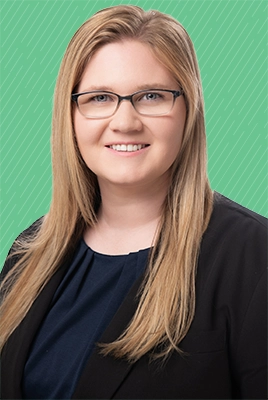 Tiffany Findlay currently serves as a lawyer at the Ohnstad Twichell law firm office
in Hillsboro, North Dakota. Tiffany completed her bachelor’s degree in Mathematics
here at UND in 2019 and her J.D. degree at the University of North Dakota School of
Law in 2022. Last summer, the Math Log editor met with Tiffany, and we discussed Tiffany’s background and her legal practice.
Tiffany Findlay currently serves as a lawyer at the Ohnstad Twichell law firm office
in Hillsboro, North Dakota. Tiffany completed her bachelor’s degree in Mathematics
here at UND in 2019 and her J.D. degree at the University of North Dakota School of
Law in 2022. Last summer, the Math Log editor met with Tiffany, and we discussed Tiffany’s background and her legal practice.
Tiffany grew up on a farm near the town of Herman, Minnesota. She began her undergraduate studies here at UND in the fall of 2016. Tiffany says that the people at UND were very nice. It was easy for students to form study groups and study together. Tiffany appreciated the wide variety of study paths that were available here. When she graduated with her B.S. degree in 2019, she completed a major in Mathematics and a minor in Psychology. She also earned a certificate in the Norwegian language. Tiffany’s favorite Mathematics courses were Calculus III, statistics, and History of Mathematics.
I asked Tiffany if her undergraduate studies in Mathematics helped her gain admission to the UND School of Law. She replied by telling an interesting story about her experiences in the Mathematics Capstone course here at UND. Several years ago, the Mathematics Department established a “Senior Capstone” course. All students completing an undergraduate major in Mathematics at UND must now complete this Capstone course. Each student in the course must conduct a special project. In this project, the student investigates some particular topic of mathematical interest and prepares a formal scholarly paper on the topic. Each student must also present a scholarly talk on his or her paper.
Tiffany’s project in the Capstone course involved the Law School Admissions Test (LSAT). The LSAT is a test that many students in the U.S. take prior to gaining admission to a law school. In her project, Tiffany gathered statistical data concerning students’ LSAT scores. She compared the LSAT scores of mathematics majors with the LSAT scores of students majoring in other disciplines. She found that the average LSAT scores of mathematics majors were higher than the average LSAT scores for students in most other disciplines.
Law School
In the fall of 2019, Tiffany enrolled as a student in the University of North Dakota School of Law. She had a heavy course load which often required her to do a significant amount of reading. She often had to read approximately one hundred pages of material each day. Much of this material involved legal cases. When Tiffany attended class after the readings, the law professor would often select a student at random and ask the student to summarize and analyze one of the cases described in the readings. The selected student would do so as the other students listened.
In March of 2020, the COVID-19 virus was spreading across the U.S. and around the world. After UND’s spring break that year, all UND instruction switched to the online format. Tiffany remembers attending law classes remotely through live Zoom meetings. Her professors continued to select students at random and ask them to summarize and analyze legal cases during class. This time, however, the students listened and watched through the Zoom meeting as the selected student explained and analyzed the case. Tiffany was able to continue her legal education during the COVID-19 epidemic, but she says that she is glad that she was able to attend traditional classes for the first few months of her law school studies.
First-year law students at UND take a special writing skills course for law students. Tiffany did well in this course, and in her second and third years of law school, she served as a Teaching Assistant for a special writing program at the UND School of Law. As a Teaching Assistant, she helped less-experienced law students with questions and issues concerning legal writing. The experience Tiffany gained from this position was very valuable to her. She was not paid for her work as a Teaching Assistant, but she received one hour of academic credit for the first semester of her work as a Teaching Assistant.
During her years as a law student at UND, Tiffany served on the boards of the Rural Practice Association and the Environmental Law Society. These groups are student organizations here at UND. Again, Tiffany was not paid for her work with these organizations, but her service provided valuable experience. The Rural Practice Association arranged meetings in which practicing lawyers and judges would come to UND and consult with current UND law students. These lawyers and judges came from many different parts of North Dakota and Minnesota. In some cases, a panel of visiting lawyers would meet with the students. The visiting lawyers would sometimes describe areas of legal practice in which lawyers could specialize. Many of the visiting lawyers came from law firms, and they would often describe the particular types of externships1 and job positions they could offer to students. The meetings between the students and the lawyers helped the students establish contacts with some of the lawyers, and Tiffany feels that these contacts were very helpful to her later on in her career.
Throughout much of her undergraduate and law school studies, Tiffany worked at several jobs outside UND. After her first year as an undergraduate student, Tiffany began work at a Ruby Tuesday restaurant. She later worked at the front desk of a hotel. In the summer of 2020, during the COVID-19 epidemic, Tiffany worked at the courthouse in Devil’s Lake, North Dakota. Some of Tiffany’s courthouse work was remote, and some was actually at the courthouse in Devil’s Lake. In the summer of 2021, Tiffany worked at a law firm in Fergus Falls, Minnesota. This was an in-person position. Tiffany actually went in to the office each day. Late in the fall of 2021, while she was still a law student, Tiffany began work at a law firm in East Grand Forks, Minnesota. She continued at this job into the spring of 2022.
The Bar Exam
Tiffany graduated from the UND School of Law with a J.D. degree in May of 2022. In the summer of 2022, she traveled to the Minneapolis-St. Paul area to take the Minnesota state bar exam. The exam was a two-day four-part exam. Tiffany spent eight hours on the exam on each of the two days of the exam. Many prospective lawyers fail the exam, but Tiffany passed it on her first attempt. By passing the exam, Tiffany was able to obtain a license to practice law in Minnesota. She obtained this license in October of 2022. By applying to transfer her bar exam score, Tiffany received a license to practice law in North Dakota in February of 2023.
While still a law student, Tiffany had received an employment offer from the Ohnstad Twichell law firm. She began service in the firm’s office in Hillsboro, North Dakota, in September of 2022. Hillsboro is a small town near Interstate Highway 29 about midway between Grand Forks and Fargo, North Dakota.
In her legal work, Tiffany specializes in estate planning and probate, as well as real estate law. She helps people write their wills. She sometimes creates trusts which people can use along with a will to pass their assets on to their heirs at the time of death. Tiffany also prepares documents which a person can use to grant power of attorney2 to his or her children or to other people.
When a person dies, a probate3 may need to be commenced with a court, where a judge would appoint a person as personal representative to manage the decedent’s4 affairs. Tiffany files pleading documents with the judge to request the appointment of a specific person to serve as the personal representative. The personal representative is given legal authority to pay any last expenses and transfer the decedent’s property to the decedent’s heirs, as named in decedent’s will or by state law. In formal proceedings or in special circumstances, the judge will require a hearing to decide whether the named personal representative should be appointed. Tiffany has been lucky so far. Up to now, she has only had to attend two or three formal hearings. Each of these hearings was a remote hearing. Tiffany appeared at the hearing through Zoom.
In Tiffany’s real estate work, she often drafts deeds to transfer the title of a piece of real property, i.e. real estate property, to a new owner. She then files the deeds with the appropriate county office. In the past, she has mailed the deeds to the county office, but some counties are beginning to use online systems which allow Tiffany to transfer the title directly from the computer in her office.
Tiffany also examines real property abstracts. A property abstract is a document which describes the history of a particular piece of real property. Tiffany looks for liens or claims on the property. This can be important when someone wishes to buy or sell the property.
These are only a few examples of the work that Tiffany does. She says that much of her work involves agriculture in some way. In the course of her work, Tiffany occasionally travels to the Ohnstad Twichell offices in the towns of West Fargo and Page in eastern North Dakota.
Mathematics and Legal Practice
Tiffany says that her legal studies and legal practice have used a significant amount of mathematics. She has encountered many situations in which one must perform numerical calculations using mathematical formulas. She specifically mentioned computations involving principle and interest, estate tax liability, and tax exclusion amounts. Tiffany also says that her past mathematical studies have helped her to develop more organized and logical ways of thinking, and that this has helped her in her law studies and law practice.
Tiffany spends a large amount of time at her desk working on paperwork, but she also spends much time talking with clients in person. In some cases, her clients are grieving over the recent loss of a loved one. At other times, clients are making some very important decisions. Tiffany needs to make sure that her clients understand their options and the consequences of the decisions they are making. Tiffany knows that her words and actions can have a huge impact on her clients’ lives.
Tiffany says that her legal practice is going very well. She enjoys her work, and she enjoys the way that her job allows her to help other people. But Tiffany also says that she has to continually learn new things. To retain her law licenses, she must read about recent court rulings and changes in the laws. She also attends seminars on these topics.
Tiffany and her husband Jesse live in Hillsboro. In her spare time, Tiffany enjoys puzzles and baking. She also enjoys visiting with family and friends at her family’s lakeshore property near the town of Fergus Falls, Minnesota.
I asked Tiffany if she had any words of wisdom for alumni and current students. She responded by urging students and alumni to meet people in their areas of interest. She feels that her previous contacts with practicing lawyers helped her find her present job at Ohnstad Twichell. Tiffany also stresses the importance of continuing to learn. In her work as a lawyer, she needs to know many things. She could not learn all of these things during her law school studies, but law school helped her get started. In the years since her law school studies, she has continued to learn.
We would like to thank Tiffany for sharing her stories and thoughts with us, and we wish her continued success in her service as a lawyer!
- According to the American Heritage Dictionary, an extern is “a person associated with but not officially residing in an institution.” One might compare an externship with an internship.
- A person with power of attorney for another person can make business decisions on behalf of that person. This can be very important for elderly people who may soon be unable to manage their own business affairs.
- According to the American Heritage Dictionary, a probate is “the process of legally establishing the validity of a will.”
- The term “decedent” is a legal term for a deceased person.
The following persons are responsible for monetary gifts to the UND Alumni Association & Foundation specifically designated for the improvement of the Department of Mathematics. We thank you for your generosity!
Department Support
- Gregory Stolt
- Derek & Amy Schulte
- Corinne Roberta Jacobson
- Sandra & Richard Paur
- John Clynch
- Patricia & Gordon Henry
- Rodney & Marlys Kjellberg
- Gail S. Nelson
- Julie Getty
- Nadjah Larson
- Daniel G. Hinnenkamp
- Rodney McKinney
- Elizabeth Jessen
- Michael Kalina
Deann and Lee Christianson Scholarship
- Drs. Deann & Lee Christianson
Joseph A. Guzek Mathematics Scholarship
- Joeseph & Joyann Guzek
Judy Ann Utton Memorial Scholarship
- Bruce Anderson
Paul Bruce Waterside Enterprises Scholarship
- Paul V. Bruce
David Uherka Mathematics Scholarship
- Dr. & Mrs. David Uherka
Brent Christensen Mathematics Scholarship
- Brent M. Christensen
Ronald C. and Ann C. Bzoch Memorial Scholarship
- Maryanne & Russ Romero
- Dr. L. Thomas Ramsey
Patrick Durkin Memorial Scholarship
- Mark Gonitzke
- Christopher Smith
- Marilyn Holweger
- Leslie Durkin
Jay O. and Marie Bjerkaas Math Scholarship
- Forrest & Susan Bjerkaas
If you would like to make a monetary contribution to UND, to the UND Mathematics & Statistics Department, or to one of our scholarship funds, visit the UND Alumni Association & Foundation.
Keep in Touch
We'd love to hear from you!
Previous Issues
Contact us by email for copies of previous issues of the Math Log Newsletter.