Laser Communication Optical Ground Station
State-of-the-art ground station laser communications research facility set to begin operations in 2026.
Supported by funding from the North Dakota State Legislature, the University of North Dakota Free-Space Optical Communication Lab is under development. This secure laser communication facility will be the first of its kind among universities. In addition to housing innovative technology and research, the lab will provide unique opportunities for educating and training students for the future.
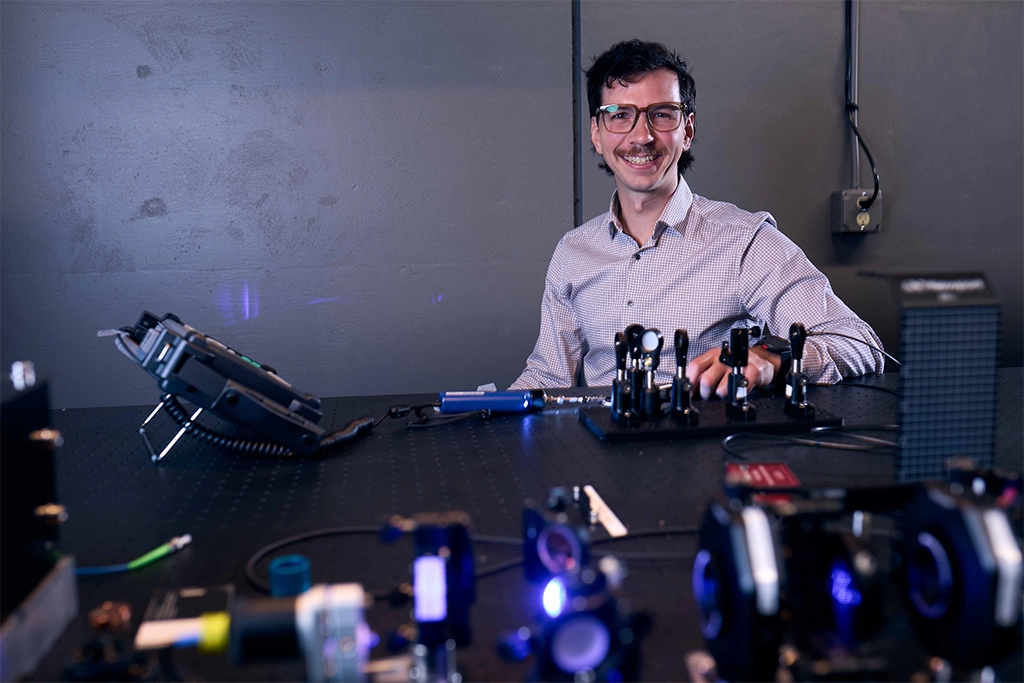
Free-Space Optical Communication
- Technology that uses light, typically from a laser, to transmit encrypted data wirelessly over distances
- Faster, cheaper, more reliable, and more difficult to intercept
- 10-100 times faster than traditional radio frequency
- Provides internet to traditionally inaccessible locations (remote/rural)
Elevating Satellite Communications
Free-space optical communication with satellites promises to increase the channel
bandwidth by orders of magnitude compared to traditional radio frequency (RF) communication,
however, the technology is in its infancy and many challenges need to be addressed.
Stability of optical ground stations and payloads, protocols, laser and detectors,
spacecraft tracking, and security in the physical layer are all subject to active
research. This facility places UND in a unique position to carry out this research
and support government and industry partners.
The facility includes an indoor laboratory space that houses most of the transmitter
and receiver hardware as well as additional rack space and optical tables for user
equipment.
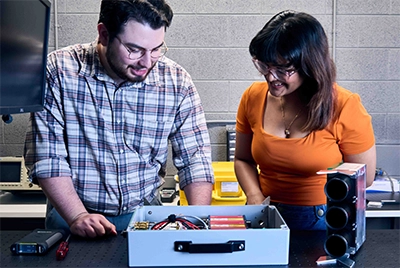
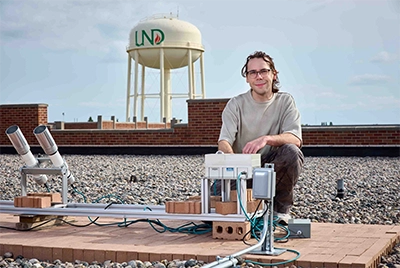
Witmer Hall will house a rooftop installation with the core component of the ground station: a fully enclosed, automated telescope with a 70-cm main aperture and adaptive optics.
The rooftop installation also features a suite of atmospheric and meteorological monitoring equipment to perform site characterization and monitoring to the full extent recommended by the Consultative Committee for Space Data Systems (CCSDS). This data will provide potential users with a comprehensive picture of site conditions and expected down-time due to inclement weather.
The two spaces at Witmer Hall will be connected with optical fibers. These and other
spaces at UND dedicated to the National Security Initiative at Harrington Hall and
the Tech Accelerator will be connected through a continuous dark fiber network that
will enable us to carry out hybrid network research for quantum communication.
The main laser communications backbone is a set of free-space modem, transmitter and
receiver hardware that fully supports optical communication terminal standard laid
out by the Space Development Agency. Users can integrate payloads either directly
on the telescope, or at the interior lab space, and access a 3.5 km-roundtrip free-space
beam line on campus.
Planned Capabilities
- Fully functioning ground station for laser communication (with aircraft and LEO spacecraft)
- Full support for SDA OCT Standard 3.1.0 (Beacon-less telecom-wavelength optical on-off-keying - O3K)
- Partial hardware support for CCSDS 141.0-P-1.1
- Up to 10 Gigabit/s symbol rate, x20 faster than best radio-frequency link to LEO
- Gigabit-rate quantum communication with state-of-the-art optical receiver by JPL (1st commercial system)
- Array of light sources for quantum encryption, satellite laser ranging, and clock synchronization
- On-campus free-space test path, integration of user payloads
Future Research Directions
- Integration of FSOC payloads, FSOC link analysis
- Multi-purpose optical payloads for small-sats: Carry out sensing (LiDAR, Imaging) and FSOC in a combined payload, increase functionality with limited size, weight and power (SWaP)
- Certifiably unbreakable encryption using device-independent quantum key distribution (funded through NSF National Quantum Virtual Laboratory Program)
- Penetration testing for FSOC and quantum key distribution satellite missions